


Upcoming Events

Declaration 250 – August 1-2, 2026

In partnership with The Perry Group, Lake Eerie Heritage Foundation will help host Declaration 250, a national commemoration marking the true signing date of the Declaration of Independence on August 2, 1776.

This once-in-a-generation program will feature speakers, living history, community participation, and a ceremonial signing event at Perry’s Monument.

While July 4, 1776 marks the adoption of the Declaration of Independence, it was on August 2 that the majority of the 56 signers actually affixed their names to the document, risking their lives and livelihoods in defense of liberty. “Declaration 250” aims to restore the historical significance of this day by organizing a ceremonial re-signing of the Declaration at Perry’s Victory and International Peace Memorial, one of America’s most symbolic sites of unity and peace. 

The two-day celebration in the village of Put-In-Bay, Ohio, will feature tall ships, living history performances, keynote speakers and community leaders from across the nation. Nationally syndicated radio host, Hugh Hewitt, will be the master of ceremonies, and The Ohio State University Marching Band will perform. 

All members of the United State Congress will be invited to physically sign the ceremonial 250th anniversary Declaration of Independence. The event will culminate with a firework display. Schools, veterans, historical groups and civic organizations are encouraged to participate in this once-in-a-generation event.

See the latest details here.

Past Events

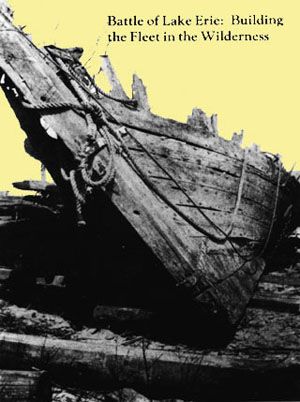
Battle of Lake Erie: Building the Fleet in the Wilderness

Battle of Lake Erie: Building the Fleet in the wilderness book cover

Stern view of USS Niagara just after she had been raised from Misery Bay, April 2, 1913. “Perry’s Victory Centennial Souvenir: The Niagara Keepsake,” p. 18.

by Radm. Denys W.Knoll, USN (Ret.)

Washington D.C.: Naval Historical Foundation Spring 1979

Beginning in 1615 missionaries and explorers, principally French, paid visits to the Presque Isle (now Erie, Pa.) region of Lake Erie but no permanent white settlement was made until 1794 because of hostile Indians. In 1753 the French permanently established a transportation system of land and water routes from the St. Lawrence River to the Mississippi River. It went via Lake Ontario with land portage at the Niagara escarpment, thence across Lake Erie to Presque Isle (Erie), where another 14-mile land portage to Fort LeBoeuf (Waterford) connected with French Creek which flowed into the Allegheny at Franklin, thence onward to the Ohio and Mississippi Rivers and ultimately to the French settlement at New Orleans.

France and England hoped in the late Eighteenth Century to extend their colonial boundaries westward, but French control in North America was doomed with the British victory at Quebec in 1795 during the French and Indian War (Seven Years War). With the Peace Treaty of 1783 (ending the Revolutionary War), the British lost control of the south shore of Lake Erie. Indians, normally very loyal to the British, continued to harass white settlers.